
Developing an Out-Of-Order RISC-V CPU: part one
This post is about 5 months late. I created the markdown file on 12/23/2025 but never got around to writing anything to it. Now, I have some time on my hands (and I feel bad about not writing as often as I had planned to) - so I figured I will give this a shot again.
Last fall, I took ECE 411 the infamous computer-architecture class at my university. This was a class I was really looking forward to. After dealing with some department advising beauracracy (and almost losing my seat in the course) I did end up taking the class - and I quite enjoyed it. The final project of the class involves designing a Out-Of-Order RISC-V CPU. This blog post is going to hopefully go over
- Theory of Operation for OOO CPUs
- My experience writing the RTL
- Exposing the rationale for some design choices
EDIT: I am an hour into writing this post. It is clear to me that is going to be hard to fit a semester’s worth of content into a single blog post. Therefore I have decided to split this into 2 posts. This one will focus on theory of operation and the next one will cover my personal experience developing the project, and some exciting news for the future. Hopefully it doesn’t take me another 6 months to write it XD
What is Out-Of-Order?
If you’re not already familiar - I would recommend you look at
In most computers - memory is very limited. CPU registers are implemented using flip-flops which are power hungry, and occupy considerable area. As such you end up consuming a lot of power/area per bit. BUT, the CPU gets instant access to the register. Therefore, the number of CPU registers is usually constrained to a number that optimizes Power/Area/Efficiency for a given use-case. For example, the RV32-I spec of RISC-V comes equipped with 32 32-bit CPU registers.
In order for you to run any non-trivial program - you need fast access to memory. Caches are usually implemented in SRAM, which give you better power/area but are much slower. If the data you want is not present in the cache, then you go to DRAM which is cheaper than SRAM - but slower and physically far away from your CPU –> which means even slower access times.
And if the data you want has not been paged to DRAM, you go hunting for it in your HDD/SSD which is an incredibly slow process for a Processor that runs at MHz/GHz frequencies.
Getting back to why Out of Order Matters
Say for example you are attempting to perform the following operation on
 1. c = b + M[d]

 2. a = c + b

 3. d = d + b
This is a straightforward addition operation. Let’s assume c, b, d, and a are registers.
M[d] means we are attempting to “dereference a pointer”
, i.e. access the data stored at the memory address whose value is stored in register d
For the sake of our example, let’s say the data at address d is not present in the cache
- what happens? The Memory System goes up the memory hierarchy searching for it. Depending on the state of your computer - it make take anywhere between 10 to thousands of CPU cycles to get that data (AMAT).
A traditional in-order pipelined/multicycle CPU would have to stall all the pursuant instruction until this memory read is resolved, and only then will execute instructions 2 and 3.
This is a huge waste of time. The fetch, decode and execute stages/hardware of the CPU just sits there - unutilized while we wait for the memory system to respond. OOO tries to fix this problem by exploiting Instruction Level Parallelism
Now let’s take a look at instructions 2 and 3. Evidently, instruction 2 is dependent on the outcome of instruction 1. What about instruction 3? It has no dependency on Instructions 1 or 2.
An OOO CPU is capable of executing instructions Out-Of-Order and this example is a great scenario where an OOO processor would utilize it’s “free” hardware resources to execute the pursuant “independent/ready” instructions.
How does it work - Tomasulo
Out of order processors are not a new idea. IBM had already come up with an OOO hardware algorithm back in 1967. I highly recommend watching this video for a more visual explanation. It is what I used to get a sense of what is going on when I took the class, and is probably far better than my attempt here.
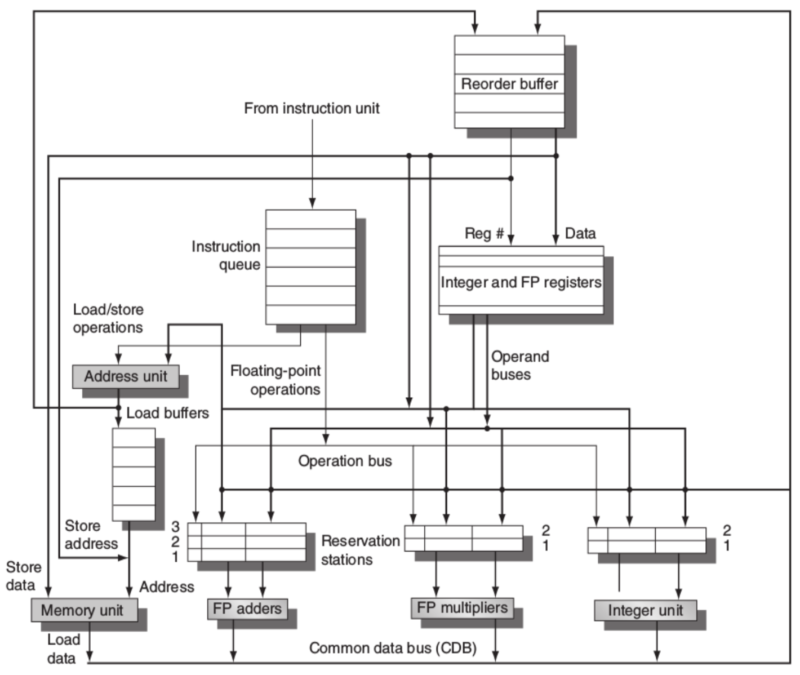
The basic principle of this algorithm, called Tomasulo’s Algorithm - is that instructions are issued in-order, executed out-of-order, and committed/written-back in-order.
In a Tomasulo processor, there is one common frontend (fetch, decode, issue) - multiple “functionl units” (which are ALUs and Memory Units for load/stores). Once executed - the functional units send the result to the commit buffer / reorder buffer - that commits the results of the instruction in-order.
Each kind of functional unit has a queue known as reservation stations.
The reservation stations control when an instruction can execute
Each functional unit has a tag . The reservation stations, and the FUs are connected through a Common Data Bus. Each “broadcast” of a completion from the FU is accompanied by a tag
Instuctions are fetched and decoded in order, and then placed in the issue queue.
Each register/operand in an operation is assigned also assigned a tag - via a technique called “Register Renaming”. In Tomasulo, each operand is assigned a “tag”. Unused registers have a special tag. Registers that are already in use - are assigned a placeholder tag - usuallly pointing to the tag of the functional unit where we expect the result to originate from.
Let’s go back to my initial example
 1. c = b + M[d]

 2. a = c + b

 3. d = d + b
In RISC-V memory and arithmetic operations cannot be muddled. So let’s change the example a little
 0. e = M[d]

 1. c = b + e

 2. a = c + b

 3. d = d + b
Execution Flow with Tomasulo’s Algorithm:
Instruction Fetch and Decode:
- All three instructions are fetched and decoded in order. The CPU identifies the operations and operands involved.
Issue Stage:
Cyle 0 Issued Instruction 0:
e = M[d]- Since this is the first instruction, let’s assume all the registrers and reservation stations are available
- This is a load operation. Let’s assume loads take 4 CPU cycles.
dis immediately available to use, so it has a tag of0- since
eis the destination, it’s tag is changed from0toL(the tag of the memory FU - it can be any arbitrary distinct number) - This instruction is now in the RS for Memory FU and will executing in 4 cycles
Cycle 1 Issued Instruction 1
c = b + e- This is an arithmetic operation. Let’s assume it takes 1 cycle to execute
- The CPU checks if
bis available. It is, so a tag of0 - The CPU checks if
eis available. It has a tag ofL - Since
Cis the destination register, it is tagged toA(the tag associated with ALU) - This is issued to the Reservation Station for the ALU. Howe
- Since the operand for Instruction 0 is available, it starts being executed by the memory FU
Cycle 2 Issued instruction 2
a = c + bcis dependent on the result of Instruction 1, so it takes on the tag ofAbis tagged as0since it is readily available.- Instruction 2 is also issued to the RS for the ALU FU
- Instruction 0 is on the 2nd cycle of execution
- Instruction 1 is waiting for a broadcast on the CDB associated with the tag
Lso it can mark its operand as ready and begin execution
Cycle 3 Issued Instruction 3
d = d + b- This instruction can proceed independently as it only requires
dandb, both of which are available with tag0. - It is issued to the ALU RS
- Instruction 0 on it’s 3rd cycle
- Instruction 1 waiting for broadcast with tag
L - Instruction 2 waiting for broadcast with tag
A
- This instruction can proceed independently as it only requires
Cycle 4
- Instruction 0 on it’s 4th cycle
- Instruction 1 waiting for broadcast with tag
L - Instruction 2 waiting for broadcast with tag
A - All the operands for instruction 3 were ready, so it is being executed by the ALU FU this cycle
Cycle 5
- Instruction 0: The load finally completes. The FU can broadcast its result with tag
L - Instruction 3: This also finishes (in one cycle). The ALU FU can also broadcast a result with tag
A
Now - there is only one CDB connecting the RSs and FUs. It is the “common” bus after all. Which FU can broadcast comes down to an arbitration policy. Let’s assume that the memory FU gets first pick. So the tag
Land result is broadcasted. Since the ALU FU can’t broadcast - it stalls this cycle. (NOTE: There are a lot of CDB arbitration policies, including having multiple CDBs. We will discuss this more in the next blog post)- Instruction 1 receives broadcast with tag
L- but the ALU FU stalls since Instruction 3 was unable to broadcast - Instruction 3 waiting for tag
A
- Instruction 0: The load finally completes. The FU can broadcast its result with tag
Cycle 6
- Instruction 3 broadcasts its result, and the ALU accepts the next available instruction to exec
- Instruction 1 now being executed.
- Instruction 2 is still waiting
- Instruction 4 is now being committed/placed in Reorder buffer (ROB)
Cycle 7
- Instruction 1 broadcasts
A, ALU ready again - Instruction 2 operand becomes available, starts being executed by ALU
- Instruction 3 in Reorder Buffer, waiting to for previous instruction to be be committed
- Instruction 1 broadcasts
Cyle 8
- Instruction 1 comits
- Instruction 2 finishes and broadcasts
- Instuction 3 waiting in ROB
Cycle 9
- Instruction 2 commits
- Instruction 3 waiting in ROB
Cycle 10
- Instruction 3 commits
Now obviously I have glossed over some of the details here. Reorder Buffer and commits form different stages of the backend of the CPU.
There is an increased pipeline depth in out of order processors due to more need of processing instruction dispatching
But we were able to demonstrate how instructions were able to execute out of order.
The main reasons for stalls in such a processor come from
- ROB getting full - this happens when an instruction in the “Head” of the ROB takes particularly long to complete, and all pursuing instructions complete and occupy the ROB, but can’t be committed because the instruction at the head hasn’t committed. This is also known as ROB Starvation
- Reservation Station getting full
- Issue queues getting full
Making these structures larger allows us to exploit bigger ILP windows - but also increases the combinational logic needed to make decisions on readiness - limiting clock speed, increasing area and power consumption.
The Alternative: ERR
There is another alternative to Tomasulo’s algorithm: Explicit Register Renaming.
I found these slides that have some nice visuals on ERR. The key difference between ERR and Tomasulo is that ERR de-links scheduling and renaming. Instead of “tagging” registers to functional units - we have an architectural register file and a physical register file. The physical registers are far more than the architectural registers. For example my project CPU had 64 physical CPUs - and only 32 architectural registers. here is a Register Alias Table (the RAT) that keeps track of which physical registers map to which architectrual registers. Kind of like a hash table. There is also a retirement RAT which keeps track of mappings after instruction have completely finished execution and have been committed. This helps us deal with branches (which I will talk about more in my follow-up post).

Each Functional unit has it’s own issue queue. which holds instructions that have been dispatched. The issue queue contains some issue logic - which is a muxtree that “dispatches” instructions with ready operands to the functional unit.
ERR can be explained with the following examples:
i0. x1 = x2 + x3
i1. x4 = x1 + x5
i2. x1 = x5 + x2
i3. x5 = x1 + x2
Let’s assume our CPU spec presents only 5 architectural registers (x1 - x5). In an ERR processor, we have
physical registers - usually more than the number of architectural registers. In our case, let’s say we have
10 physical registers (p1-p10).
The instructions abover present 3 types of “dependencies”:
- Read after Write (RAW): Instruction 0 and 1
- Write after Write (WAW): Instructions 0 and 3
- Write after Read (WAR): Instructions 2 and 1, Instructions 3 and 2
To make the hazards posed by these data dependencies clear - let’s assume that the ALU takes 3 clock cycles to complete a 32 bit addition. We have 2 ALU Functional Units in this ERR CPU. Let’s assume for the sake of simplicity, that the issue queues have a depth of “2” (these are usually parameterized)
Execution Flow with ERR
Instruction Fetch and Decode: All the instructions are fetched, and decoded sequentially - and placed in the instruction queue Since there were no instructions prior to these - all the hardwware resources in the deeper stages of the CPU (issue queues, ROB) are unoccupied. So instructionsd are sent to the issue queues as they arrive
Cycle 0:
i0dispatched from instruction queue to issue queue. Since x1 is the destination being written to - it is mapped to some physical registerp2during the issue logic. This is usually done using a bitvector known as the free list. The RAT is updated to reflect the new mapping
Cycle 1
i0moves from issue queue (IQ1) and starts being executed byALU1. 2 more cycles to go for it to finish executioni1dispatched from instruction queue to an issue queue. Let’s say we have a random policy to choose which non-full IQ an instruction is issued to. So it is now sitting inIQ2. During the issue logic - we know that thatx1is mapped top2- which is used as one of the operands. Since thex4is being written to - it is remapped to the next free physical registerp3. The RAT and free list are updated to reflect this.
Cycle 2
i0on its 2nd cycle of executioni1waiting inIQ2forp2to be become available - a RAW dependency - the only “true” dependencyi2dispatched randomly to an instruction queue 2IQ2. This queue is now full. This instruction also writes tox1. However,i0also does that…. what’s going on? This is our Write after Write dependency. However, since it isx1we are writing to - we can simply map it to a new free physical registerp4. This in no way affects the execution ofi1. This new mapping also ensures that thex1used as an operand ini1is not affected by the write, since it relies on the old-mapping top2- enforcing correctness and eliminating the Write after Read dependency. Therefore it is possible to executei2beforei1without affecting the correctness of the operations - since they were issued in-order.
Cycle 3
i0on its last cycle of executioni1waiting inIQ2forp2to be become availablei2moves fromIQ2toALU2and starts executingi3dispatched toIQ1- waiting on the results ofi2or forp4to become free (RAW)
Cycle 4
i0finishes execution and moves to the ROB to be committed. Depending on how forwarding is implemented the issue ques may be immediately aware ofp2becoming available, or only after being committed. In order to keep this example short, let’s assume some sort of same-cycle CDB–>IQ forwarding mechanism is in place.i1ready now, since it has its operandp2ready. HoweverALU2busy so it needs to waiti2on its 2nd cycle of execution inALU2i3waiting onp4to be ready inIQ1
Cycle 5
i1waiting forALU2i2on last cycle of execution inALU2i3inIQ1waiting forp4
Cycle 6
i2completes andp4broadcasted (NOTE: This instruction will wait in the ROB untili1is committed.)i1starts execution asALU2becomes availablei3starts execution asp4becomes available
Cycles 7 and 8
i1andi3executing on the 2 ALU FUs
Cycle 9
- Both
i1andi3complete. Depending on bus arbitration policies - one, or both of them broadcast
- Both
Cycle 10 (optional)
- The remaining instruction (if at all) broadcasts
And now we have demonstrated how ERR allows for out-of-order execution, solving the problem of WAR and WAW dependencies. ERR is usually more power hungry and larger than Tomasulo style processors. The ILP window can be made larger by increasing the size of the ROB, Issue Queues, and increasing the number of FUs/CDBs
Discussion
And now I have tried to explain the basic premise of OOO cpus. Nothing beats the IPC of pipelined CPUs if memory was ideal and didn’t take ages to respond and was cheap for power/area. But OOO CPUs do a good job with what we have.
It is worth noting that branches get much more complicated to deal with in a OOO CPU. In the case of a branch resolving, and the prediction being incorrect - when said branch instruction is committed from the ROB - and the misprediction is discovered - the entire CPU is flushed. Because of the number of queues and stages in an OOO processor - this is an expensive affair - significantly degrading its performance.
Conclusion
This blog post took me a lot longer to write than I was expecting. It’s my first attempt at trying to explain a fairly technical topic over text only. I have glossed over a lot of implementation details (ROB, CDB, RAT) and only tried to convey the intuiton for how OOO processors beat certain limitations - so reading a textbook/lecture slides on this is highly recommended. It should help cement the foundation of understanding, and go over implementation details I would also recommend taking a look at
- Computer Organization and Design RISC-V Edition: The Hardware Software Interface by David A. Patterson and John L. Hennessy
- Computer Architecture: A Quantitative Approach (6th Ed.) by John L. Hennessy and David A. Patterson
- BOOM
- Processor Microarchitecture an implementation perspective
Part 2 of this will cover some of my experience designing a baseline CPU, and writing benchmarks to see what needed extra bells and whistles to run better.
If you have an ideas for improving the clarity of this writeup- do let me know :D